Background
1907-1994
The year 2017 marks one hundred years since the name of Santa Criz de Eslava was first reflected in a scientific publication. It was in 1917 when Juan Castrillo, then parish priest of Sada, published in the Bulletin of the Commission of Monuments of Navarra a milestone of the emperors Maximino and Máximo dated in the year 238 AD and found in the Fuente del Moro, northeast of the Santa Criz hill. He would later be followed by another milestone of the emperor Probo –from the years 276-282 AD– that would appear in the Bulletin of the Royal Academy of History published by Fidel Fita (1835-1918), one of the great scholars of Antiquity from the late 19th and early 20th centuries.
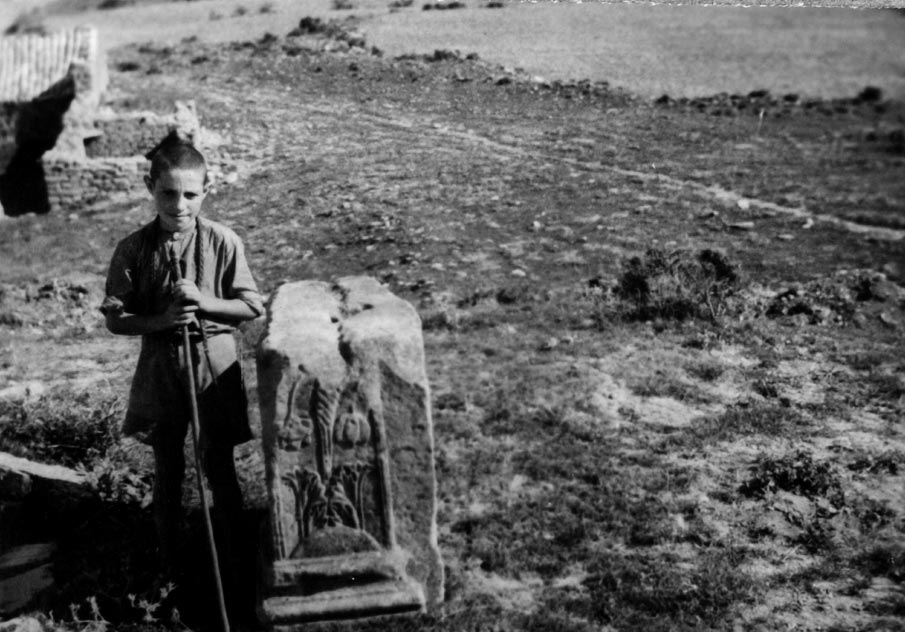
The repercussion of these publications led Julio Altadill (1858-1935) and, especially, the Jesuit from Javier Francisco Escalada (1870-1946), to call attention to the presence in Santa Criz of an important Roman city at the foot of the road then called “Jaca-Rioja”. Although neither Altadill nor Escalada carried out excavations in the place, we owe to the second the discovery of a good number of inscriptions both in La Venta de Eslava and in El Solano de Aibar, some of which, after being exhibited in the archaeological collection of the PP. Jesuits of Javier passed to the Museum of Navarra that, in fact, keeps a good batch of material especially epigraphic.
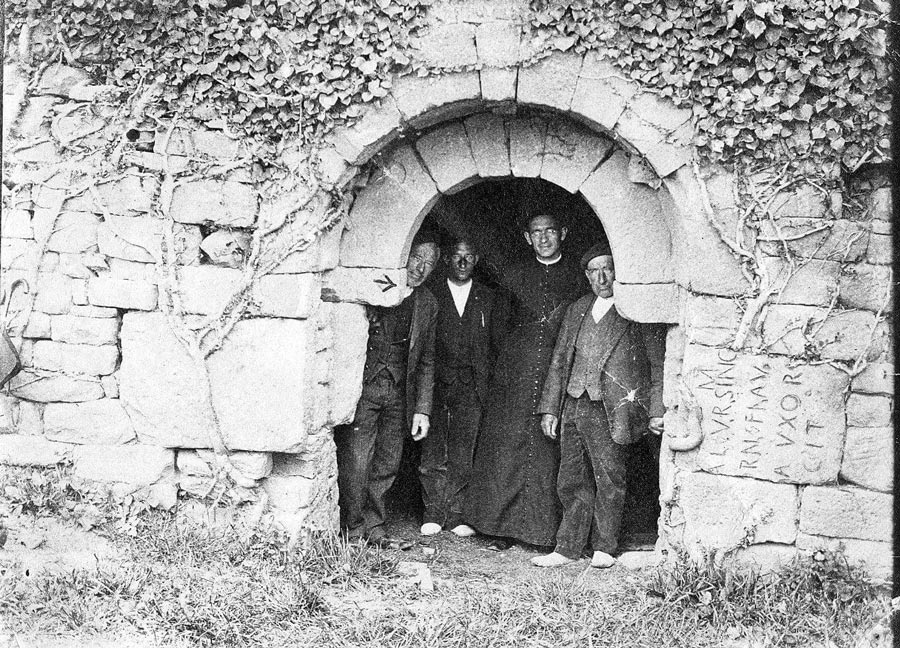
The first soundings would not arrive until 1946 and would be the work of the great fathers of Roman Archeology in Navarra, Blas Taracena (1895-1951) and Luis Vázquez de Parga (1908-1994) who excavated in the upper part of the hill discovering the foundations of a large public building, now covered by weeds. They did it in the context of their work in Los Casquilletes de San Juan de Gallipienzo where they found a Roman funerary inscription and important reliefs on which José Mª Blázquez (1926-2016) would later be interested, just in the years in which José Rubio (1926-1987) or Antonio García y Bellido (1903-1972) also announced important materials from the city, such as the plate of the dispensator Athenio or the altar to the deus magnus Peremusta, offered by Aracca Marcela.
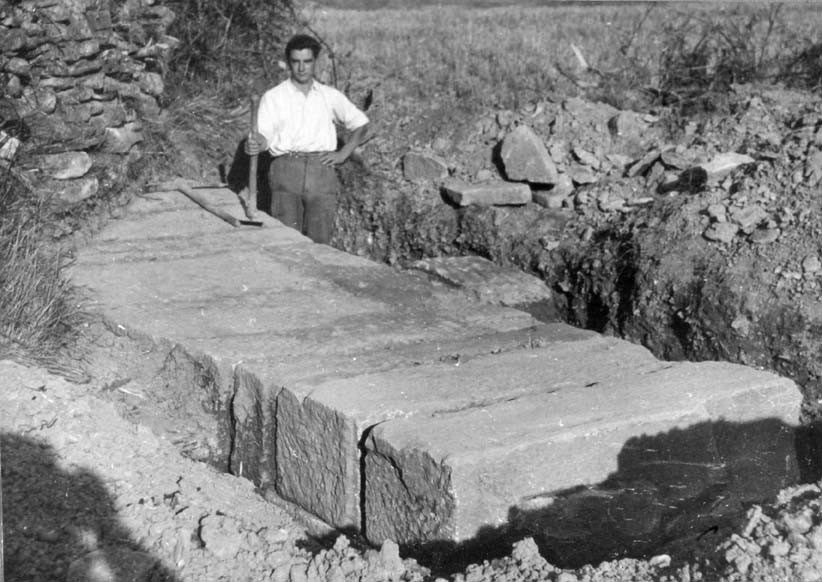
But, really, Santa Criz de Eslava would not come to light until the late 90s. It was then when, thanks to the City Council of Eslava, Cederna Garalur and the Government of Navarra, the archaeologists Tx. Mateo, R. Armendáriz and P. Sáez would initiate periodic excavations in the place supervised by the Historical Heritage Service of the Government of Navarra. The findings of the necropolis, first, and of the southern sector of the forum, later –with notable architectural and monumental elements– have ended up turning Santa Criz de Eslava into one of the most attractive Roman enclaves in Navarra, an enclave to which, now, hundreds of visitors give life weekly.
Eslava Town Council
Calle Inmaculada 36
31494, Eslava, Navarre
T 948 733 012
Cooperative Winery
Hours
Monday to Friday
9:00 AM to 2:30 PM
admon@bodegaeslava.es
Bar
Hours
Monday to Sunday
1:00 PM to 2:30 PM and 5:30 PM to 9:30 PM
Shop
Hours
Monday to Friday
9:00 AM to 11:30 AM
Website has been financed by the Next Generation EU funds and included within the Recovery, Transformation and Resilience Plan, Digital Spain 2025 and the SME Digitalization Plan.

2025 © Eslava Town Council