The pre-Roman City
It must have been in 195 BC when the armies of Rome, which were already encamped in the northern peninsula, came into contact with a Vascon-type fort located on top of a steep hill now known as Santa Criz, on the banks of the Indusi River and with an extraordinary dominance over the Val de Aibar and the Aragon River valley.
The fort, which would double in size in Roman times – at which point it reached some 13 hectares – had a fortified enclosure, partly taking advantage of the rocky outcrops on the eastern part of the hill and partly from the construction of a powerful masonry wall. The nearby presence of the Fuente del Moro and the Pisaldea ravine would guarantee the water supply, while the Aragon valley allowed communications with the Pyrenees and the Ebro valley.
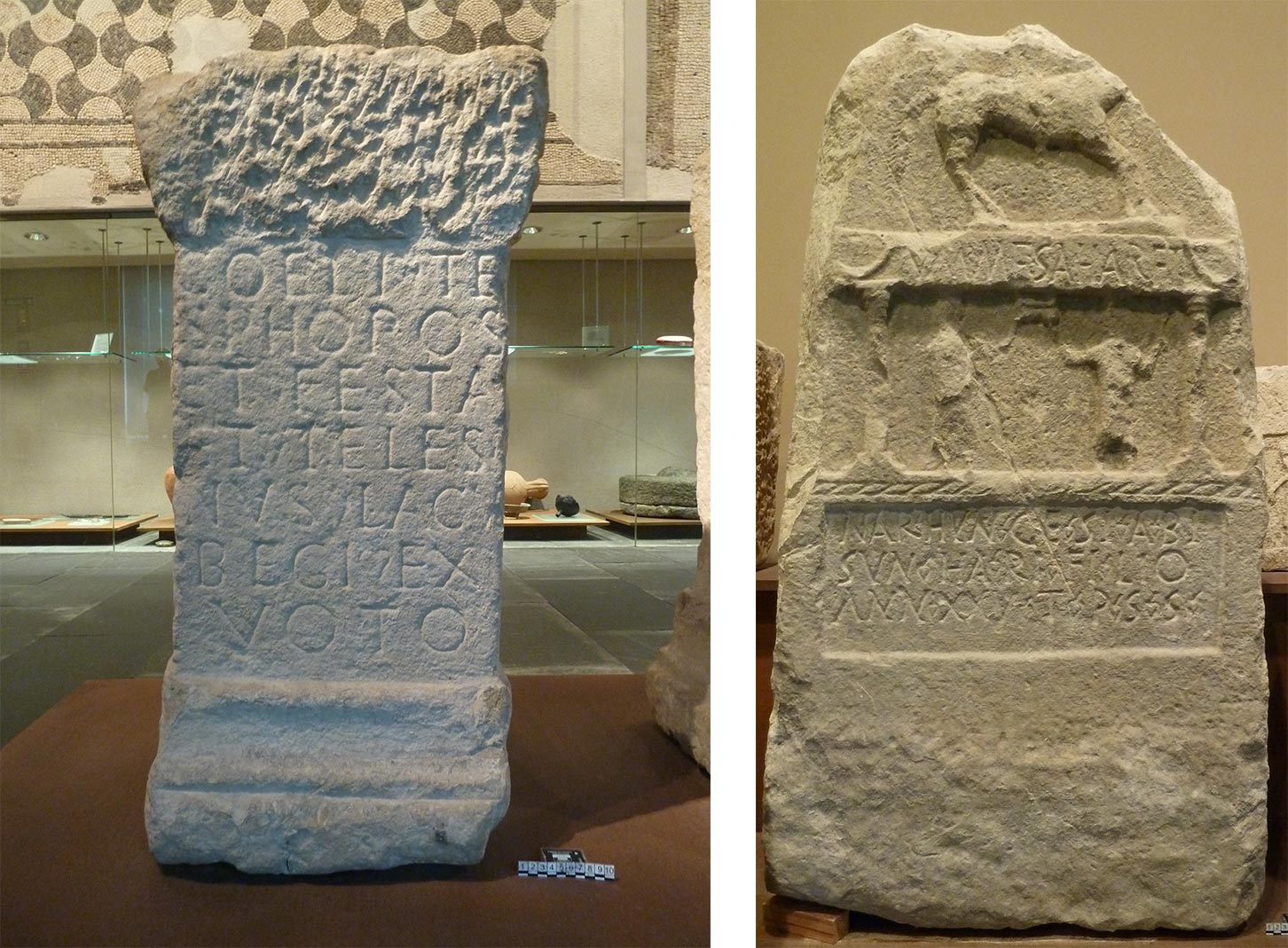
The votive and funerary inscriptions recovered in the neighboring towns of Ujué and Lerga – with allusion to the god Lacubegi and the anthroponyms Abisunharis and Narhungesi – suggest a Vasconic population for the aforementioned fort, although in recent years research has revealed the general diversity that, in linguistic, ethnic and cultural terms, characterized the ancient Vascones, tributaries since the time of Augustus of the conventual capital, Caesar Augusta.
The exact name of the city, which has long been known by the enigmatic hagiotoponym of Santa Criz, is unknown. It has been suggested that it could be Nemanturista or Biturís, both cited by Ptolemy among the póleis attributed to the Vascones already in the 2nd century AD. C. Both hypotheses, unfortunately, cannot yet be confirmed.